Thermal camera for car checks: AC, cooling, brakes and tires
Summer is hard on a car. The AC runs flat out, the cooling system works hardest in traffic on a hot afternoon, and a long road trip is exactly when you don't want a dragging brake or a tire that's been low for weeks. Most of these problems change how hot something gets, which is why a thermal camera for car checks is so useful.
Short answer: A thermal camera for a car shows surface temperature, so it helps you compare AC vents, radiator hoses, brakes and tires side by side. It can point to a dragging caliper, a blocked radiator or a weak vent in minutes. It doesn't read codes or replace a mechanic, and it's for parked checks, not driving.
It won't replace a mechanic, but a few minutes in the driveway show what's worth a closer look, with a picture to show the shop.
What can a thermal camera for a car actually show?
Thermal imaging for cars comes down to one idea: compare parts that should be alike. Left against right, one vent against the next, today against the last time you checked.
| Part | How to compare | What stands out |
|---|---|---|
| AC vents | Vent against vent | One vent warmer than the rest |
| Radiator | Top to bottom, side to side | Cold vertical strips |
| Brakes | Left wheel against right wheel | One side much hotter or colder |
| Tires | Across the tread | One edge or the center running hotter |
If you're new to the picture on the screen, start with our guide on how to read a thermal image. Reflections and emissivity matter even more on metal and glass.
Before you start: safety
- Never use the camera while driving. Every check here is done parked, on level ground, with the parking brake on.
- Hot parts stay hot. Brake rotors, the exhaust and the radiator can burn you long after you stop. Look, don't touch, and never open the radiator cap on a hot engine.
- Keep the phone, the cable and your hands away from belts and the radiator fan. On many cars the electric fan can start on its own after the engine is switched off.
- Don't go under a car held up only by a jack. Use ramps or proper stands, or skip the checks underneath.
1. How do you check the AC with a thermal camera?
Run the AC on its coldest setting with the fan on high for a few minutes, then scan the vents from the passenger seat. It takes about 5 minutes.
Every vent should be clearly colder than the dashboard around it, and all of them similar. What stands out:
- One vent clearly warmer than the others on a single-zone system: often a flap behind the dashboard that isn't moving properly, rather than the refrigerant.
- One side warm on a dual-zone system: check each side's temperature setting first. If both are on coldest and one side still blows warm, it's worth a visit to the shop.
- Every vent only slightly cooler than the cabin: the system isn't cooling well. Low refrigerant is a common cause, but not the only one.
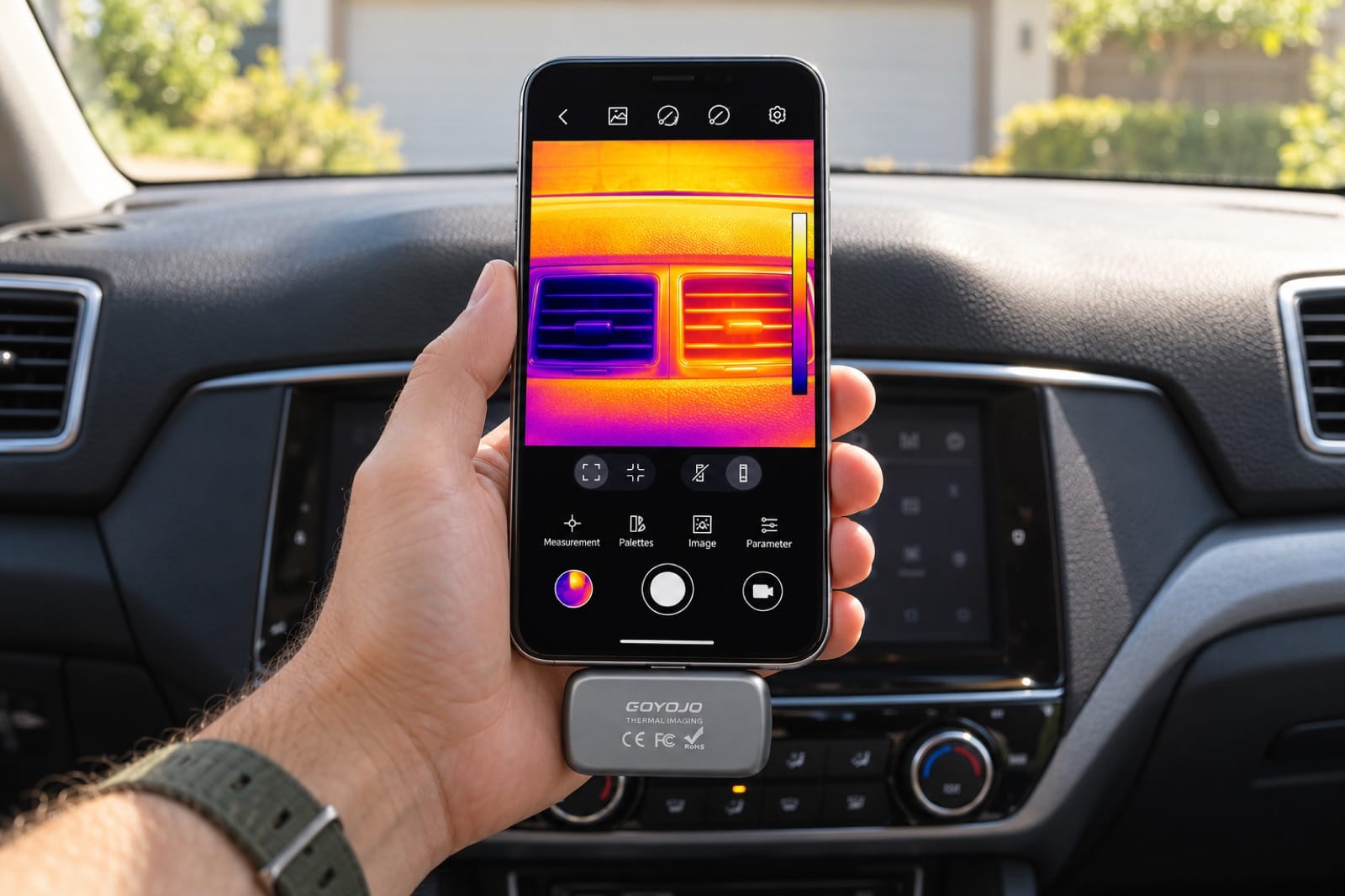
Illustration: with the AC on full, one center vent blows cold and the other doesn't, which usually points to a flap behind the dashboard rather than the gas.
The camera reads the vent slats, not the air itself, so use it to compare vents. For a single number, a probe thermometer in the center vent does the job. Our comparison of a thermal camera, night vision and an IR thermometer explains why those tools give different answers.
Under the hood, with the AC running, you can also look at the two metal pipes that run to the firewall. One is usually thin and hot, the other thicker and cold, sometimes with a little condensation on it. If the thick pipe isn't cold at all, the compressor may not be engaging or the system may be low. Leaves and bugs packed into the condenser, the radiator-like part at the very front, are easiest to spot with your eyes.
Refrigerant isn't a DIY job: recharging and leak repairs are for a licensed AC technician.
2. Can a thermal camera find a cooling system problem?
Often, yes. The cooling system works hardest on hot days, in traffic and when towing. Let the engine reach normal temperature, switch it off, then scan from above, keeping well clear of the fan.
- The upper radiator hose should be hot, and the lower one noticeably cooler.
- The radiator core should show an even gradient, hottest where the coolant comes in and cooler where it leaves. Cold vertical strips can mean blocked tubes.
- A radiator and upper hose that stay cool while the temperature gauge climbs can mean a thermostat stuck closed or poor circulation.
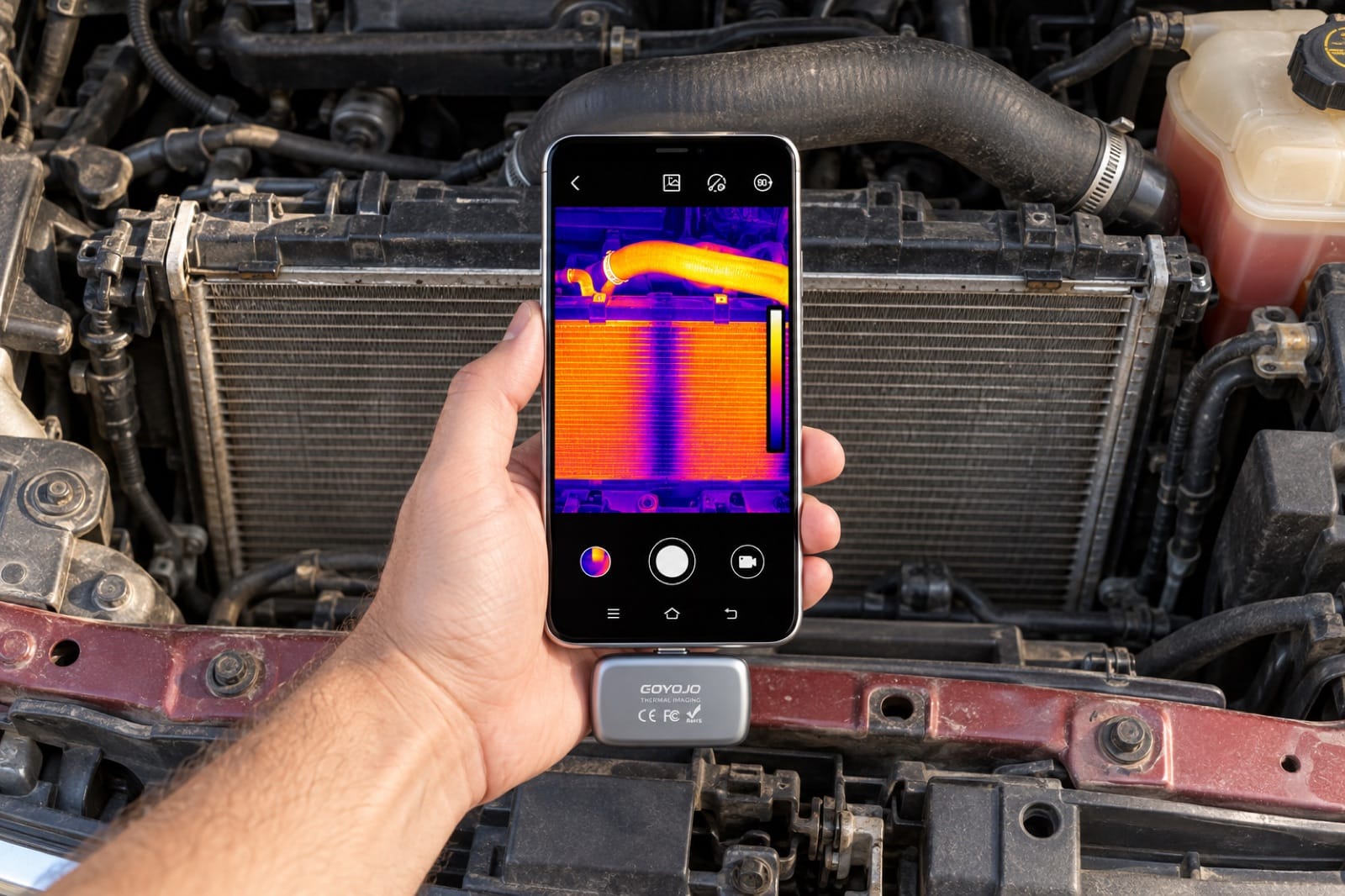
Illustration: the upper hose is hot and the radiator warms evenly, except for one cold strip where tubes are likely blocked.
Once it has cooled, check the coolant level against the marks on the reservoir, and look for crusty residue around hose clamps: a sign of a slow leak.
3. How do you find a dragging brake?
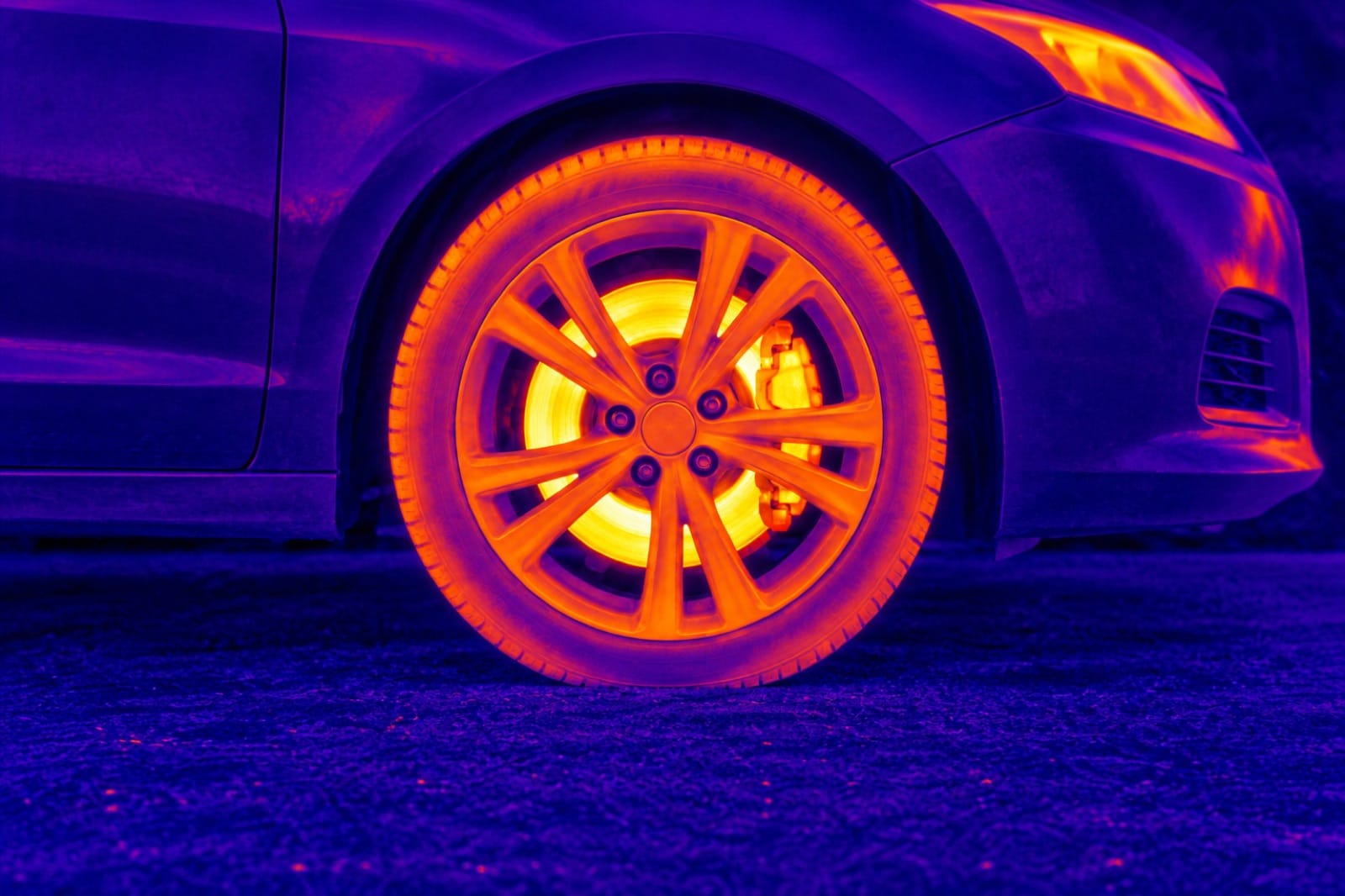
Drive for 10–15 minutes with normal stops, park, and scan each wheel right away from the same distance and angle.
| What you see | What it can mean |
|---|---|
| Front wheels warmer than rear | Normal: the front brakes do most of the work |
| One wheel clearly hotter than the other on the same axle | A brake that drags: a sticking caliper or slide pins, or a parking brake that doesn't fully release |
| One wheel clearly colder than the other on the same axle | That brake isn't doing its share |
| A hub much hotter than the others, brakes look even | Possibly a wheel bearing, especially if you hear a hum or grinding |
Summer adds one trap: a wheel parked in direct sun reads warmer than one in the shade before you've driven anywhere. Compare a quick scan before the drive with one after it.
The shiny friction surface of a brake rotor reflects heat and reads too low. The caliper body, the hub and the rusty edge of the rotor read more honestly. Compare left with right on the same parts, and the comparison works even when the exact number doesn't.
4. What can tire temperature tell you?
Underinflated tires flex more and run hotter, and hot roads add to that. After a drive, look across each tread:
- Hotter at both edges than in the center can hint at too little pressure.
- Hotter in the center can hint at too much.
- Hotter on one edge only can point to an alignment problem.
These differences are small and easy to misread: treat them as a reason to check the pressures with a gauge, not as a diagnosis. Check them cold, before you drive or after the car has stood for a few hours, against the placard on the driver's door frame. Hot tires read higher, so don't let air out of them after a drive.
5. Heat inside the parked car
Scan a car that's been parked in the sun and the camera shows why it feels like an oven: the dashboard, the steering wheel and dark seats are among the hottest surfaces, and metal buckles on seat belts and child seats can be hot enough to hurt a child's skin. A windshield sunshade, a towel over the child seat and a hand on the buckles before strapping anyone in all help.
The camera can't see through the windows, because glass blocks the infrared it sees, so scan with the doors open. And no thermal check changes the main rule: never leave children or pets in a parked car, even for a few minutes.
6. Look inside with an inspection camera
When you need to see the part itself, an inspection camera goes where your eyes can't.
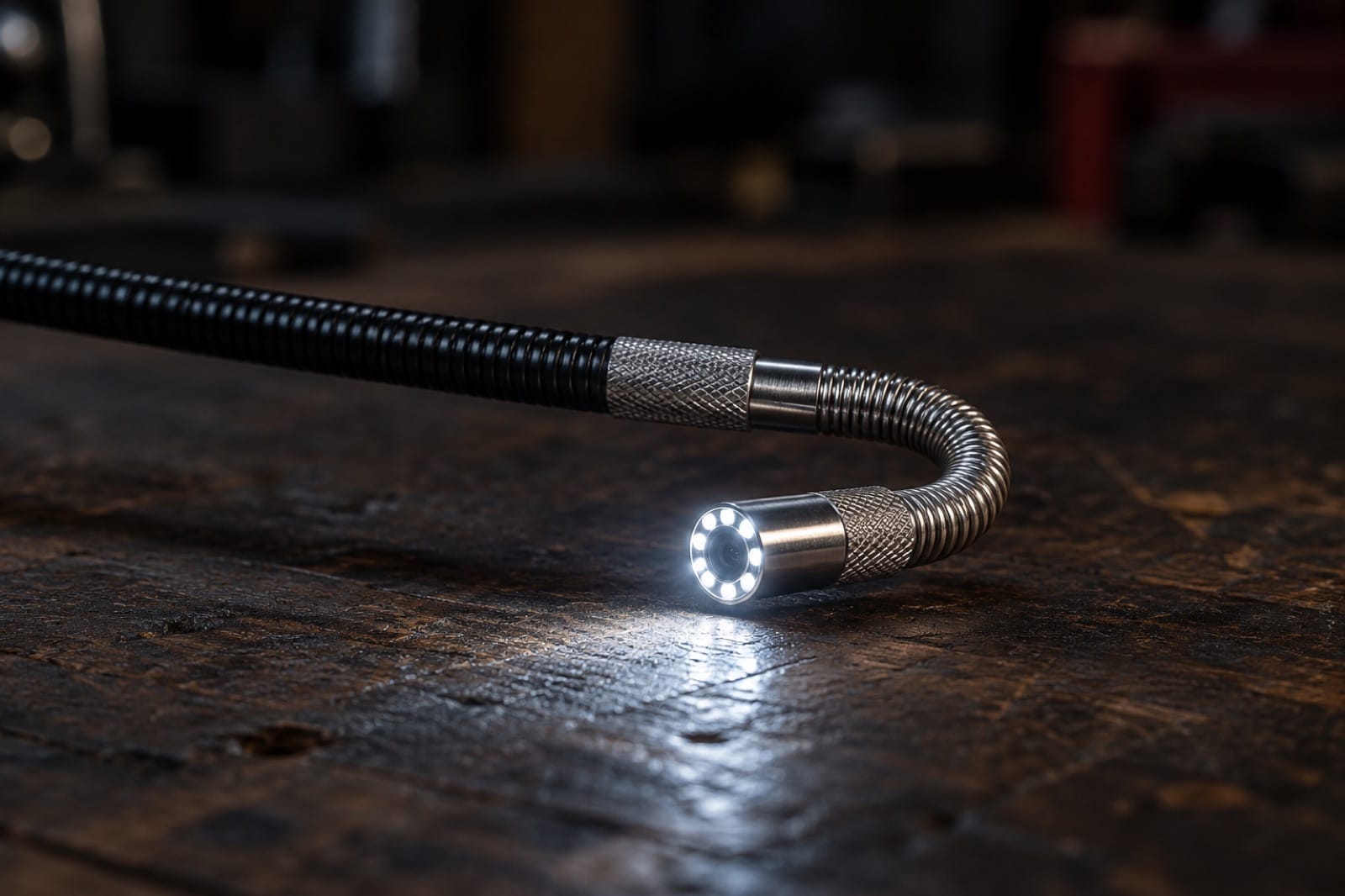
Reach Duo has two cameras in its tip, one looking forward and one to the side, LED lights and a 1 m cable. Its USB-C plug comes with Lightning and micro-USB adapters, so it works with iPhone 14 and older, iPhone 15 to 18 and Android phones. Around a car:
- Down a spark plug hole on a cold engine, if the tip fits your engine's plug hole: blow the well clean with compressed air first so no dirt falls in, then look at the top of the piston and, with the side camera, the cylinder wall.
- Inside doors and behind trim to find a rattle or a dropped key without removing the panel.
- Inside frame rails and rocker panels through the drain holes, to check for rust.
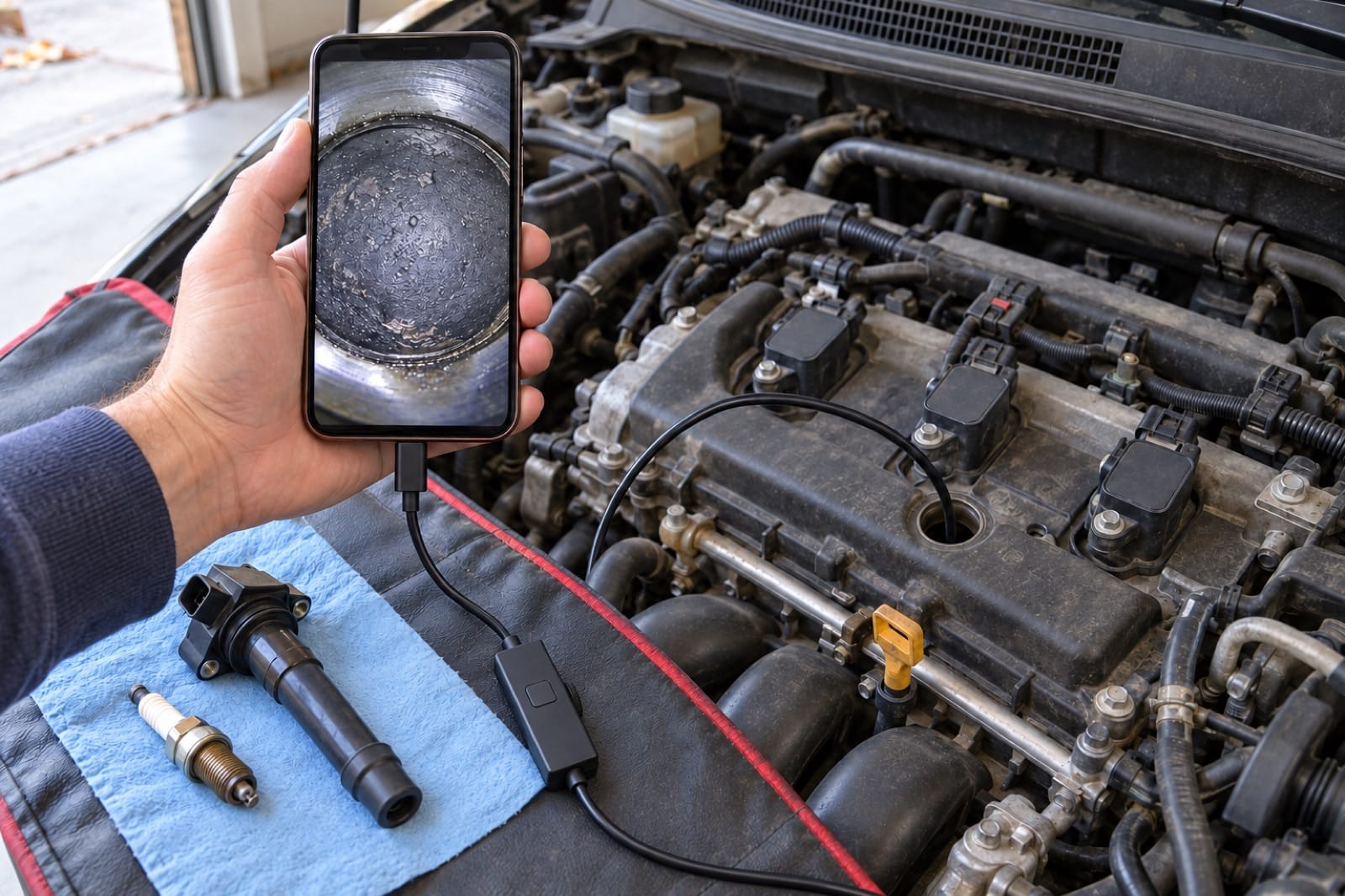
Illustration: with the spark plug out and the engine cold, the inspection camera shows the top of the piston without taking the engine apart.
Keep the tip away from hot parts and moving parts, and out of fuel. Our guide to dual-lens and articulating inspection cameras explains which design suits which job.
Can you use a thermal camera for night driving?
Not this kind. Many search results for a thermal camera for a car are about night-driving systems: cameras fixed to the vehicle that show people and animals on a dedicated screen. That's a different product. A phone thermal camera is a handheld inspection tool, and looking at a phone while driving is dangerous, so it stays parked.
What a thermal camera can't do on a car
- It doesn't read error codes or see inside the engine or transmission.
- It can't measure refrigerant or tire pressure. Gauges do that.
- It doesn't replace a brake inspection. If a wheel runs much hotter than its partner, or the car pulls to one side, have the brakes checked by a mechanic.
Frequently asked questions
What is the best thermal camera for a car?
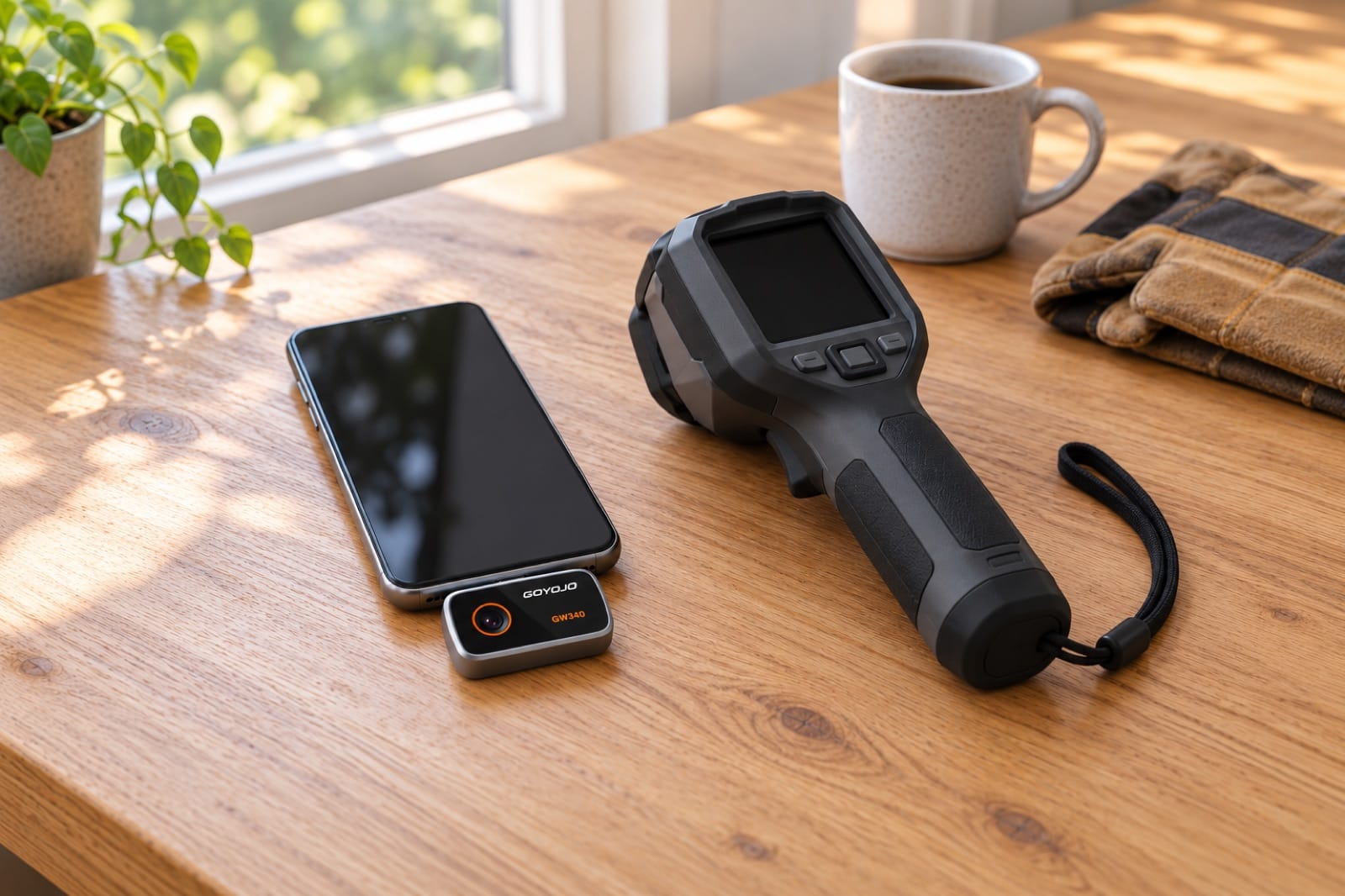
Look for enough resolution to separate a hose or a caliper from what's around it, a temperature range that covers hot engine parts, and a size that fits under the hood. A phone module is handy because it's small and saves images straight to your phone. Our Spark Pro comparison with FLIR, Topdon and Thermal Master sets out the published specs side by side.
Can a thermal camera find a misfire?
It can give you a clue. On many engines, a cylinder that isn't firing properly sends cooler exhaust out, so right after a short run its exhaust runner may read cooler than the others. Compare them from a safe distance and treat that as a hint only. Exhaust layouts and heat shields often hide the view, so confirm the result with a code reader or a mechanic.
Can a thermal camera find a battery drain?
Sometimes. A circuit that keeps drawing power after the car is locked can warm a fuse, relay or module slightly, and a scan of the fuse box may show which one. Let the car sit first so that normal warmth fades. Small draws may not show at all, so a multimeter is still the proper test. If nothing stands out, that doesn't prove the circuit is healthy.
What else can you check on a car with a thermal camera?
Heated seats and the rear window defroster are easy ones: turn them on and look for a section that stays cold, which suggests a broken element or grid line. A thermal camera can also show a wheel hub that runs warmer than its partner. For any of these, compare with the matching part on the other side before you decide that something's wrong.
Does a thermal camera work on a cold engine?
Only for a few things. Most faults show up as a temperature difference, so a car that has sat overnight looks almost uniform on the screen. Run the engine to normal temperature for cooling checks, drive with normal stops for brakes and tires, and switch on the AC for vents. Inspection cameras are the opposite: use them on a cold engine.
The tools in this guide
Prices are on each product page, in your local currency.
- Spark Pro — 256 × 192 thermal pixels, −20 to 350 °C: compare vents, hoses, radiators, brakes and tires from a step away.
- Reach Duo — inspection camera with front and side cameras and a 1 m cable, for iPhones (Lightning adapter in the box) and Android phones (USB-C, micro-USB adapter in the box).
Check the car before the trip, not on the side of the road. Order Spark Pro, and add Reach Duo to look inside doors, trim and engines.